Read waterproof claims through the closure and intended use
Separate a fabric rating from seam construction, closure limitations and the intended use of the complete bag.
Updated:
Read the claim at the right level
A waterproof claim needs a named object and a defined scope. A rating for fabric is not automatically a rating for the complete bag, its closure or a device placed inside it. Read the manufacturer’s intended use and exclusions before comparing impressive-looking numbers. Sea to Summit’s product guidance distinguishes fabric, seams and closure; its Evac bag page specifically warns that water can seep through a roll-top during submersion. Preserve that limitation beside the product name. A tidy photograph with droplets on the exterior does not demonstrate underwater protection, and a retailer’s broad waterproof category should not replace the exact product instructions.
Sea to Summit waterproof scope ? Sea to Summit AU Evac Dry Bag dimensions ?
Do not turn a fabric head into a depth promise
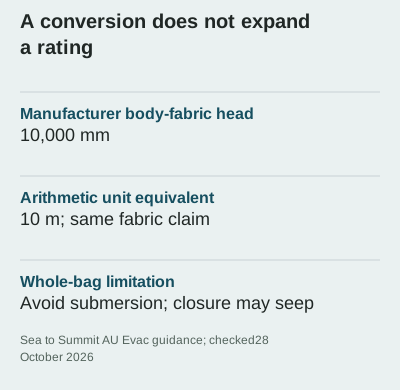
The Evac product page lists a body-fabric hydrostatic head of 10,000 mm while separately warning against submersion. Checked on 28 October 2026, those statements have different scopes. Converting 10,000 mm to 10 m does not create a whole-bag depth rating or permission to immerse the closure. The arithmetic unit conversion leaves the underlying claim unchanged. Record the original test descriptor and the complete product limitation together, without inventing a duration or a pressure test for the assembled bag. If electronics protection matters, obtain applicable product advice and consider the consequence of failure rather than using a fabric number as an equipment guarantee.
Record the closure arrangement actually described
Save the instructions that apply to the exact size and construction, including the maker’s stated closure condition. In the Evac table, the 5 L row’s 32 cm height is given with the top rolled three times. That condition belongs with the dimension. It should not become a universal closure recipe for another bag. If a seller’s picture shows a different arrangement, ask for clarification rather than deciding which image looks more protective. Damage, contamination, wear or altered parts require appropriate product-specific advice. This guide does not define an acceptable defect size or supply a home pressure-test procedure that could certify continued protection.
Keep a packing observation within its limits
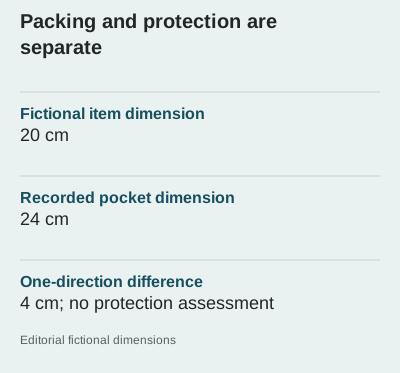
A dry, land-based packing check can record whether the intended items and specified closure arrangement can be accommodated without declaring waterproof performance. In a fictional example, an item envelope is 20 cm long and a separately measured usable pocket dimension is 24 cm, leaving a 4 cm difference in that direction. That is not proof that a rigid object fits the complete bag or that the closure will protect it. Preserve the other dimensions and the observation method, and avoid forcing corners or sharp components against the fabric. A successful packing photograph should remain a packing observation, not be relabelled as an immersion test or a flotation assessment.
Compare offers on the same claim
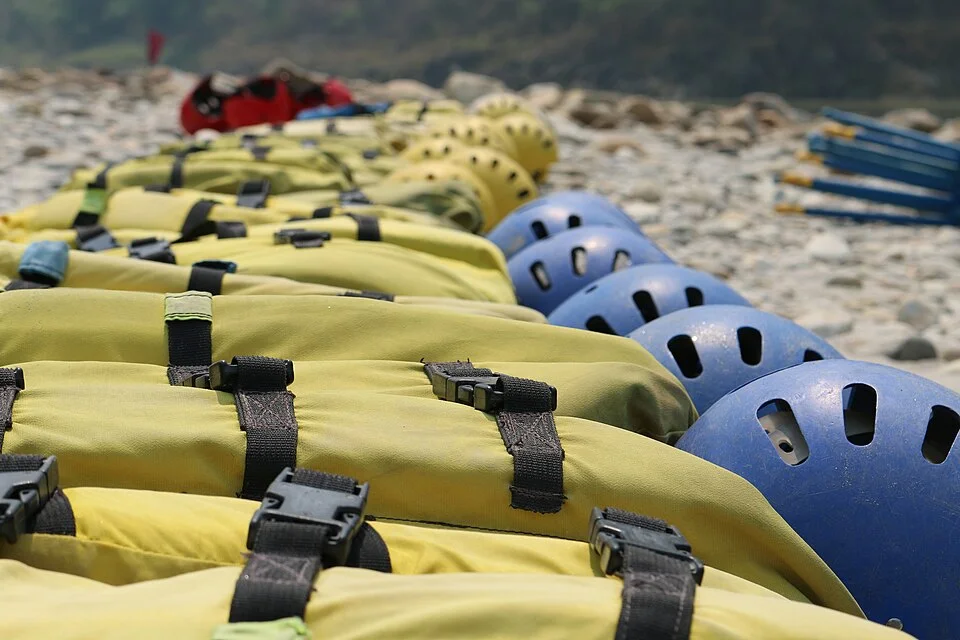
Place intended use, construction, closure limitation and product size beside the price when comparing options. If one offer lacks a clear manufacturer source, mark protection as unconfirmed instead of importing a rating from a similarly named item. Keep the receipt and relevant dated guidance so future wear or replacement questions can be directed to the correct supplier. The diagrams separate a fabric conversion from a fictional packing difference; no underwater capability is established. Real equipment photographs are contextual and do not show a tested Evac sample. Our cover is a labelled AI concept. The useful outcome is a bounded description of what the maker actually claims, plus the unresolved protection questions that still need an applicable answer.
Open official source ? Open official source ?